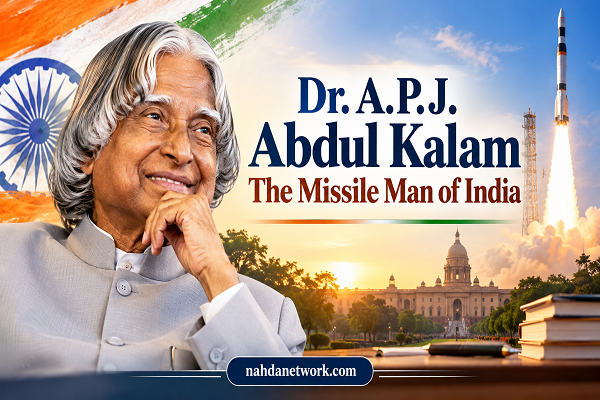
Dr. A.P.J Abdul Kalam was one of those Personalities who were born in an ordinary family and with their remarkable contributions and unprecedented services brought honours to the country, and earned international fame and recognition with his researches and experiments. He created turmoil in the scientific society. His full name was (Avul Pakir Jainulabdeen Abdul Kalam) widely known as the “Missile Man of India” and he served as the 11th President of India, from July 25, 2002 to July 25, 2007.
He was born in Rameswaram, Tamil Nadu on October 15th 1931 in a middle class family. His father Jainulabdeen, was a boat owner and Imam, while his mother, Ashiamma was a house maker. He had three elder brothers and one elder sister and one younger sister. His family faced financial difficulties. Kalam had to sell newspapers to support the income of his family. His dream as a child was to become a fighter pilot.
No doubt, Dr. Kalam came from a humble background and remained frugal throughout his life. Even after achieving significant success and earning a substantial salary as president, he maintained a simple lifestyle. He donated a significant portion of his income to various charitable organizations and educational trusts. He also established the “Purush Arambha” program to support underprivileged students and provided scholarship.
Dr. Kalam received his basic education in Ramanathapuram, then attended Schwartz Higher Secondary School. Thereafter, he joined Saint Joseph’s College, Tiruchirappalli, and later the Madras Institute of Technology (MIT). He specialized in aerospace engineering at MIT.
His contribution to the nation building:
Dr. APJ Abdul Kalam’s achievements are vast and varied, spanning science engineering and leadership. He is best known for his pivotal role in India’s civilian space program and military missile development, earning him the moniker the “Missile Man of India”. Beyond his scientific contributions he served as India’s 11th President and was a strong advocate for youth empowerment and national development.
His leadership at DRDO and ISRO was instrumental in India’s advancements in missile technology and space exploration. From 1992 to 1999, Dr. Kalam was the chief scientific adviser to the Prime Minister and the Secretary of DRDO. He played a crucial role in the development of missiles like the Agni and Prithivi series and contributed to India’s nuclear capabilities. Besides, he proposed a comprehensive roadmap for India’s development, focusing on key areas like agriculture, healthcare, education infrastructure and IT.
Dr. Kalam’s seven best inventions are: (1) India’s first Indigenous Hovercraft, (2) India’s first Satellite Launch Vehicle, (3) INCOSPAK Committee (4) Ballistic Missile Project, (5) Integrated Guided Missile Development Program, (6) Kalam – Raju Stent (Universal Healthcare Plan.)
As a matter of fact, Dr. Kalam was a National Hero. He made the country’s heart swell with pride with his myriad achievements in the field of missile research and development.
His biggest achievement in ISRO came with the successful launch of SLV- 3, which jettisoned Rohini Satellite in the near earth orbit.
Kalam’s legacy extends far beyond his technical achievements. He was a true visionary who inspired generations to strive for excellence and contribute to the betterment of society.
Dr. Kalam as the President:
He is widely known as the “People’s President”. Because he was always down to earth, refusing VVIP treatments on several occasions.
Undoubtedly, as President, he exemplified servant leadership and promoted transparency, honesty, neutrality, and inclusivity. He advocated for using technology to address issues in healthcare energy and other sectors.
More importantly, Dr. Kalam, pushed for increased access to education and technology for all Indians, regardless of their background. He also advocated for peace and human rights, and played a role in major economic reforms that boosted India’s GDP. Kalam’s tenure also saw him address controversial issues like the Office of Profit’s bill and the imposition of President’s rule in Bihar. He also handled a significant number of mercy petitions, making decisions on a few, including one for Dhananjoy Chatterjee.
Kalam championed the spread of education and technology, aiming to empower all citizens. His approachable nature and focus on citizen engagement earned him the affectionate title” People’s President”.
Besides, his presidency was marked by a focus on national development, peace and harmony. His contributions to India’s societal development were multifaceted, spanning science, technology, education and leadership.
Kalam’s work significantly contributed to making India self- reliant in missile and space technologies. He advocated for skill – based technology- enhanced education, emphasizing the need for employment generation.
Dr. Kalam and the Youth:
Kalam was a strong advocate for youth empowerment, believing that they are the key to India’s future development. He emphasized education, innovation, and a strong moral compass as essential tools for young people to shape their own destinies and contribute to the nation’s progress and prosperity.
Kalam viewed education as the most powerful tool for personal and national development. He encouraged young people to pursue knowledge with passion and purpose, emphasizing critical thinking, creativity and innovation. His vision included an education system that fostered holistic development encompassing physical, mental and spiritual growth.
He frequently interacted with students, urging them to dream big and pursue their aspirations with determination. He believed that every young person has the potential for greatness and should be encouraged to use their abilities to make a positive impact. His famous quote “What is your dream?” encapsulates his belief in the power of individual aspirations and drive societal change.
He encouraged young people to think outside the box and find innovative solutions to the challenges facing India and the world.
He emphasized the importance of taking calculated risks and not being afraid to fail, viewing failures as stepping stones to success. His own journey a humble background to becoming a leading scientist and President served as an inspiration for many. He stressed the importance of moral values, integrity, honesty, and compassion in personal and professional life.
He believed that a strong ethical foundation is crucial for building a strong and prosperous nation.
His emphasis on values aimed to instill a sense of responsibility and social consciousness in the youth.
He encouraged the youth to become leaders in their respective fields and to take responsibility for shaping India’s future. He believed that the youth are the future leaders and should be equipped with the necessary skills, knowledge, and values to guide the nation forward.
Needless to add that Dr. Kalam’s “Ignited Minds” program was a testament to his commitment to empowering young people. He actively engaged with students through lectures, interactive sessions, and his writings, inspiring them to pursue their dream and contribute to national development.
In essence, his vision for youth empowerment was multifaceted, encompassing education, innovation, values and leadership, all aimed at creating a developed India.
Dr.Kalam as a writer:
Dr. Kalam was a prolific writer. He authored a plethora of books. His illustrious publications are : (1) Wings of Fire: An Autobiography, (2) Ignited Minds: Unleashing the power with India, (3)The Luminous Sparks: A Biography in Verse and Colours: Spark of Desires, (4) Mission India: A book about India’s Future, (5) Turning Points: A Journey Through Challenges, (6) India 2020: A Vision for the New Millennium, (7) Beyond 2020: A Vision for Tomorrow’s India: A Sequel to India 2020, (8) Target 3 Billion: A book Focusing on development initiatives, (9) You Are Unique: A book aimed at inspiring young people, (10) Indomitable Spirit: A collection of his thoughts and writings, (11) The Scientific India: A Twentieth Century Perspective: A book focusing of India’s scientific achievements.
Truly speaking, titles of Dr. Kalam’s books vividly indicate how deep and profound love he had regarding his country, India. No doubt, he dedicated his entire life for the sake of the country. Besides, he always thought and discussed to make India a developed country.
It is significant to note that Dr. Kalam’s every book was sold like hot cake in the market. His books, especially, “Wings of Fire”, Ignited Minds”, and “India 2020” inspired millions and became household names.
The comprehensive knowledge and intellectual brilliance of Dr. Kalam had been acknowledged by his contemporaries. He has been accorded numerous degrees from various universities and institutions in and out of India.
Dr. Kalam received honorary doctorates from about 48 universities and institutions from both India and abroad. He has also been conferred several prestigious awards including Bharat Ratna.
Among his numerous awards were three of the country’s highest honours: The Padma Bhushan (1981), The Padma Vibhushan (1990) and the Bharat Ratna (1997).
Kalam and Religion:
Dr. Kalam was a devout Muslim. He regularly performed Namaz, fasted during the month of Ramazan and read the Holy Qur’an. Besides, he demonstrated a deep respect for all religions. He believed that all religions share the common goal of spiritual well – being and emphasizied the importance of spirituality in his own life. In his autobiography “Wings Of Fire” Dr. Kalam explicitly says, “I do not wish to set myself up as an example to others, but I believe that a few readers may draw inspiration and come to experience that ultimate satisfaction which can only be found in the life of the spirit. God’s providence is your inheritance. The bloodline of my great – grandfather Avul, my grandfather Pakir, and my father Jainulabdeen may end with Abdul Kalam, but His grace will never cease, for it is Eternal. (P.178)
This illustrious son of India died on July 27, 2015, at the age of 83. He passed away due to cardiac arrest while delivering a lecture at the Indian Institute of Management (IIM) Shillong. He collapsed during lecture and was later declared dead at Bethany Hospital in Shillong.
He was buried at Pei Karumbu Rameswaram, Tamilnadu on 30th July 2015.
Dr. APJ Abdul Kalam-The Missile Man of India
•
9 min read